




If you are an Australian professional with over $250,000 sitting in a standard retail superannuation fund, you have a dormant capital problem, lets check out the Retail Super vs SMSF Property Leverage strategy.
You likely work 60-hour weeks in a medical clinic or work remotely in mining & resources, generating massive income and employer contributions. Yet, your retirement capital sits in a pooled fund, compounding slowly on a small cash baseline. If the market dips, your wealth stagnates. If inflation rises, your purchasing power erodes.
This is the cost of un-leveraged capital.
The solution to this wealth trap is transitioning from passive accumulation to an active strategy through SMSF property investing. Tens of thousands of savvy executives refuse to remain passengers in their wealth journey. They take control.
This article breaks down the exact mathematical gap between staying in a retail fund versus deploying a leveraged physical asset strategy in 2026.
The Problem With Un-Leveraged Super
Most professionals treat their superannuation like a set-and-forget savings account. This is a fatal strategic error.
A retail or industry fund is essentially a massive pool of cash managed by institutions. While these funds provide a safe, passive return, they mathematically cap your wealth potential because they do not utilise leverage. Your money only ever compounds on itself.
If your fund generates a respectable 7% return on $250,000, you only earn returns on that specific $250,000 baseline.
The Time Penalty For Professionals
For medical specialists, lawyers, and mining workers, this lack of leverage is uniquely punishing.
Highly trained professionals spend their 20s and early 30s studying, specialising, and accumulating debt. By the time they start generating serious wealth, they face a “Late Start Penalty.” They simply do not have 40 years to wait for slow, un-leveraged compound interest to build a $3 million retirement portfolio.
They require the velocity of leverage to compress time.
Understanding The LRBA Framework (The 2026 Rules)
To bridge this mathematical gap, high-net-worth professionals step in as the CEOs of their wealth by establishing a Self-Managed Super Fund (SMSF). An SMSF allows your superannuation to legally borrow money from a lender to acquire high-yielding physical real estate.
To execute SMSF property investing safely, the Australian Taxation Office (ATO) requires a specific legal structure called a Limited Recourse Borrowing Arrangement (LRBA).
An LRBA creates a highly protected environment:
- Asset Isolation: The purchased property is held in a separate holding trust (bare trust) until the loan is repaid.
- Limited Recourse: If the property market crashes and the asset defaults, the lender’s recourse is strictly limited to that specific property. They cannot touch the remaining cash, shares, or other assets inside your SMSF.
- Tax Efficiency: Rental income generated by the property is taxed at a highly concessional rate of just 15% during the accumulation phase. Furthermore, if the property is held for over 12 months, the effective capital gains tax drops to 10%.
This completely changes the mathematical foundation of your retirement.
The 2026 Mathematical Wealth Gap
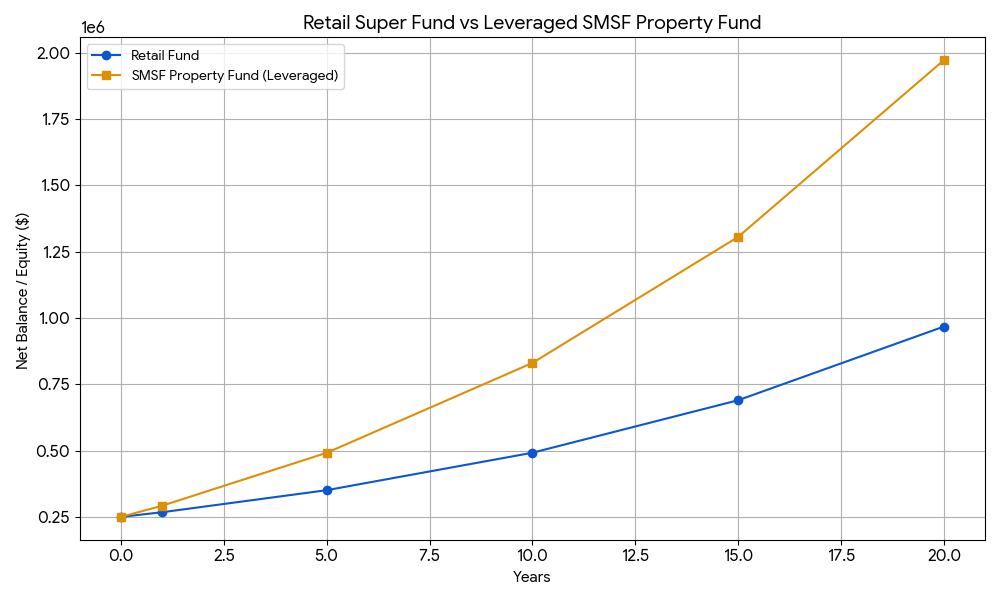
To truly understand why Wealth Strategists refuse to leave capital in retail funds, we must look at the hard data. Let’s run a 15-year projection comparing two Australian professionals. Both are 45 years old. Both have exactly $250,000 in superannuation today.
Here is why one will retire comfortably, while the other will build generational wealth.
Scenario A: The Retail Fund Passenger
Dr. Smith leaves his $250,000 in a standard industry fund. He is busy running his clinic and hopes the fund manager does a good job.
Assuming a steady 7% annual return (after standard fees), his capital compounds solely on the cash balance. Fast forward 15 years to his retirement at age 60. Without factoring in ongoing employer contributions, that initial $250,000 grows to approximately $689,000.
It is a safe result, but it will not fund a high-end, tax-free lifestyle.
Scenario B: The SMSF Property CEO
Mr. Jones engages The SMSF Property Guy to execute a leveraged strategy.
He rolls his $250,000 into an SMSF.
Mr. Jones keeps $25,000 in the fund as a strict liquidity buffer to satisfy ATO compliance and lender requirements.
He uses the remaining $225,000 to cover the deposit and acquisition costs, securing an LRBA for a $600,000 institutional-grade property plus some left over for asset diversification.
Mr. Jones is now compounding capital growth on a $600,000 asset, rather than $250,000 in cash.
If the property grows at a conservative average of 7% annually over 15 years, the asset’s value inflates to roughly $1.65 million. After paying down the remaining debt via the property’s rental yield and his ongoing employer contributions, his net equity position completely dwarfs Dr. Smith’s cash balance.
This multi-million-dollar difference is the true power of SMSF property leverage.
| Year | Retail Super Fund | SMSF Property (Gross Value) | SMSF Property (Net Equity) | Difference (In favor of SMSF) |
| Year 0 | $250,000 | $600,000 | $250,000 | $0 |
| Year 1 | $267,500 | $642,000 | $292,000 | $24,500 |
| Year 5 | $350,638 | $841,531 | $491,531 | $140,893 |
| Year 10 | $491,788 | $1,180,291 | $830,291 | $338,503 |
| Year 15 | $689,758 | $1,655,419 | $1,305,419 | $615,661 |
| Year 20 | $967,421 | $2,321,811 | $1,971,811 | $1,004,390 |
Mitigating Risk With Physical Audits
The math of SMSF property investing is undeniable. However, the execution is where busy professionals fail.
Data is only fifty percent of the equation. You can look at all the demographic and economic data in the world, but if the physical house has sub-floor dampness, structural defects, or is situated in a high-risk flood zone, your super fund absorbs the loss.
Medical specialists and mining & resources workers do not have the time to fly interstate on their weekends to inspect real estate.
The 155-Point SMSF Stress Test
At The SMSF Property Guy, we never buy sight-unseen. We act as your Execution Partner and boots on the ground.
Before we allow our clients’ super funds to secure an asset, our team flies interstate and conducts a ruthless 155-Point Physical Stress Test. We check the structural integrity, the neighborhood demographic mix, and the exact street-level owner-occupier ratios.
If a property fails a single point on this matrix, we reject it. We do the heavy analytical lifting, allowing our clients to maintain their focus on their highly demanding careers while we build their portfolio.
Conclusion: Escaping The Retail Super Trap
Transitioning from a passive fund to an active wealth strategy requires a paradigm shift. You must stop relying on anonymous fund managers to secure your financial future.
If your capital is sitting dormant, you are actively losing the leverage game. By utilising an SMSF, you secure a highly protected, tax-advantaged environment capable of holding physical, high-growth assets.
The mathematical gap between un-leveraged retail super and an LRBA-backed physical asset is simply too large for a busy professional to ignore. You need to step out of the passenger seat and into the role of CEO, without sacrificing your valuable free time to navigate complex ATO legislation.
If you have a minimum of $250,000 in superannuation capacity, it is time to map your specific financial trajectory.
Click here to take our 60-Second Readiness Assessment and see exactly what SMSF property investing can do for your multi-decade wealth architecture.